Back

Bookkeeping Score

Role
Lead Product Designer
Year
2023

I turned a dreaded chore into something people enjoyed, driving 19% of paid subscriptions

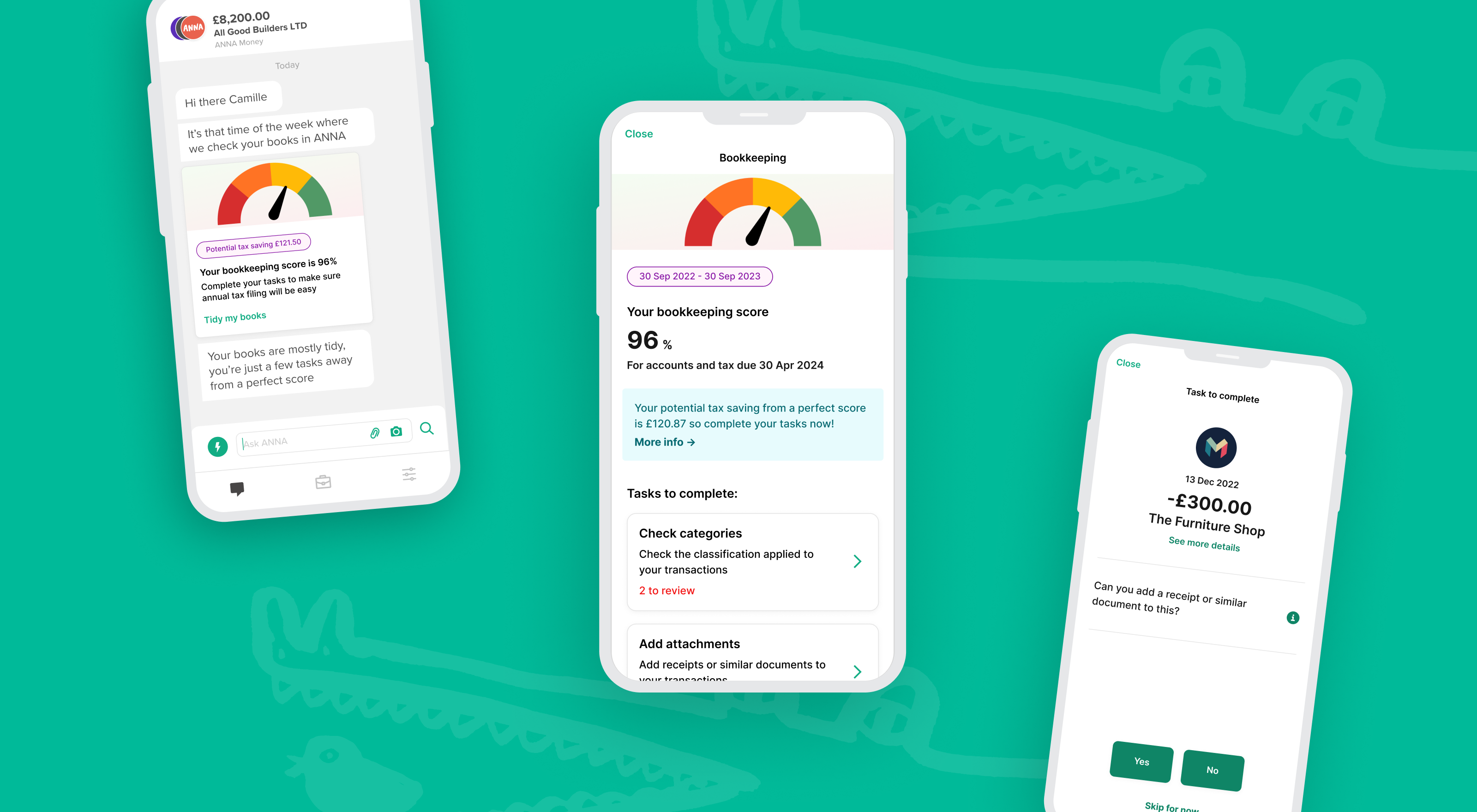
Bookkeeping Score screens in the ANNA app: a chat reminder, the score meter and a task card

Problem

ANNA’s tax product depended on tidy books, but customers weren’t doing it

Company owners on ANNA’s premium tax plan could get their Company Accounts and Corporation Tax Return each year through a monthly subscription. Producing those documents needs tidy books, and ANNA had no bookkeeping tool people wanted to use.

Only a few customers were muddling through clunky tools, with staff nudging them along. I was asked to solve this and get customers tidying their own books.

The opportunity

How might we create engagement in the difficult and dreaded task of bookkeeping?

Team size: 6
Me, 2 engineers, a data scientist, a Design Systems designer and our in-house accountant
Timeline
Around 3 months in 2023, alongside other projects
Client
ANNA Money, 100,000+ small business owners in the UK and Australia

What I did

The impact

I led experience design, from research and user testing to content creation, wireframes, flows and post-release monitoring.

I drove alignment across engineering, Data Science, other designers and our in-house accountant. The Head of Product Design and the Head of Product for Business Admin gave input and approved the final work.

  • Research synthesis
  • Ideation
  • User testing
  • Experience principles
  • Content and chat flows
  • Wireframes
  • Design system collaboration
  • Post-release monitoring
  • 79,024 tasks completed

    A huge number of bookkeeping tasks were completed. This figure covered the first 6 months

  • +13.5 points

    The average score increase in a single completed session – meaning much tidier books

  • 19% of subscriptions

    Because people liked it, the Bookkeeping Score feature drove 19% of paid subscriptions across ANNA’s in-app features

Process Step 1

I researched the customer’s point of view

I went back over the six customer archetypes our team had built from research, to understand how customers felt about bookkeeping. I pulled out five themes that I felt could shape the design.

Motivations

  • ‘Auto-pilot rocks’

    They want ‘inbox zero’, with everything done and the business running on auto-pilot.

  • ‘I can do DIY’

    Customers were used to doing tasks themselves, but wanted it to be simple and easy.

  • ‘I want to pay less tax’

    Business owners wanted to minimise their taxes, but didn’t know how.

Frustrations

  • ‘The work piles up’

    Admin gets left for the evening, the weekend or once a month, so transactions and receipts build into a backlog.

  • ‘My records are a mess’

    Cash payments, notes on paper and receipts stuffed in an envelope made it hard to keep tidy, complete books.

Process Step 2

I explored ideas and solutions

Starting from the How Might We question, I explored different ways to solve the problem, and noted my thoughts on each idea as I went.

Process Step 3

I tested the score idea with customers

I focused on the idea of users reaching a high score through bookkeeping, and built a rough interactive prototype in Figma. Early in the project, the prototype was desktop-based.

I wrote the testing questions, met 4 company owners in the UK over Zoom, recorded the sessions, then synthesised the results and shared them with the team.

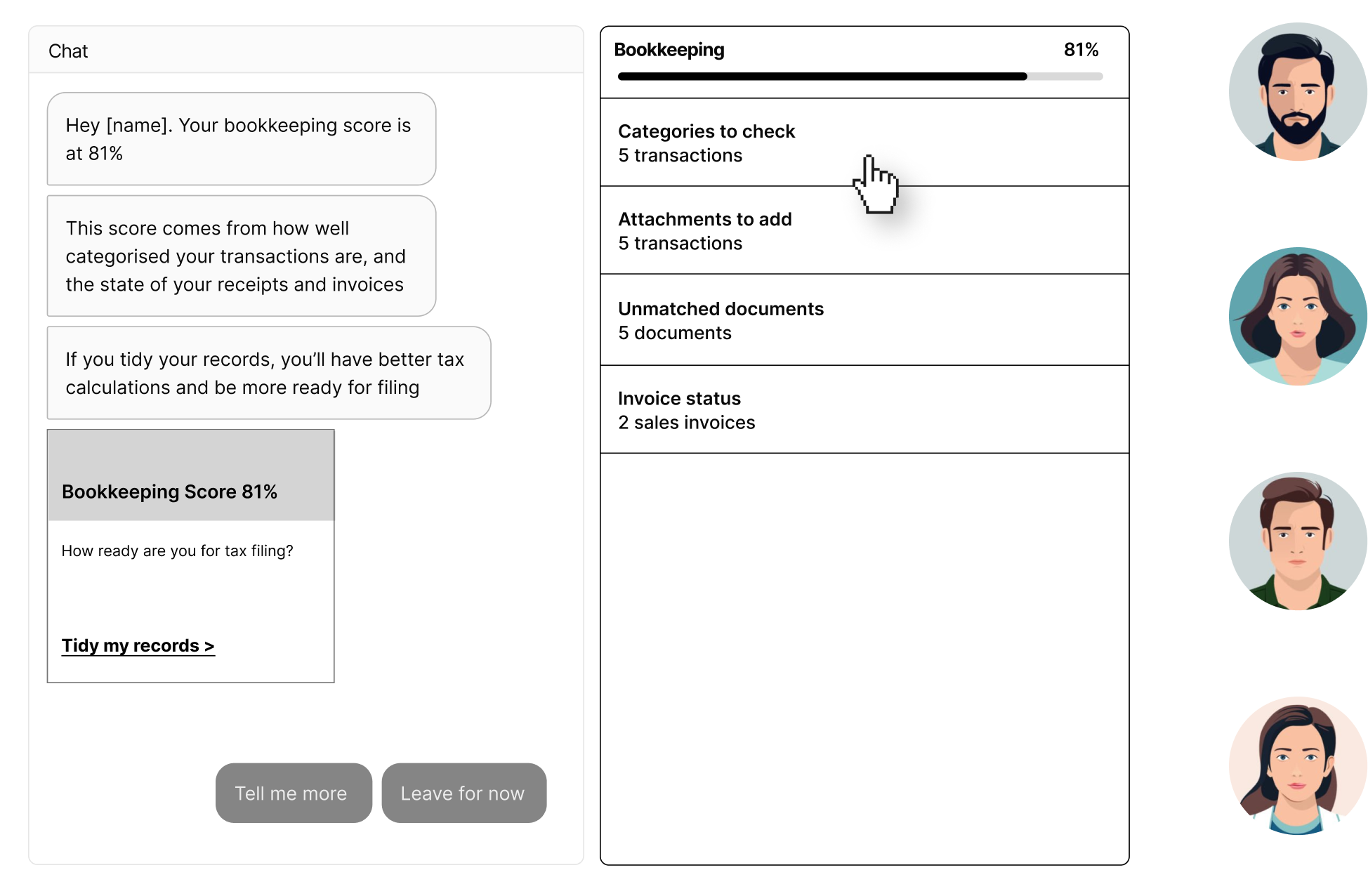
The desktop prototype showing a bookkeeping score of 81%, beside photos of the four test participants

Process Step 4

I used feedback to improve the solution

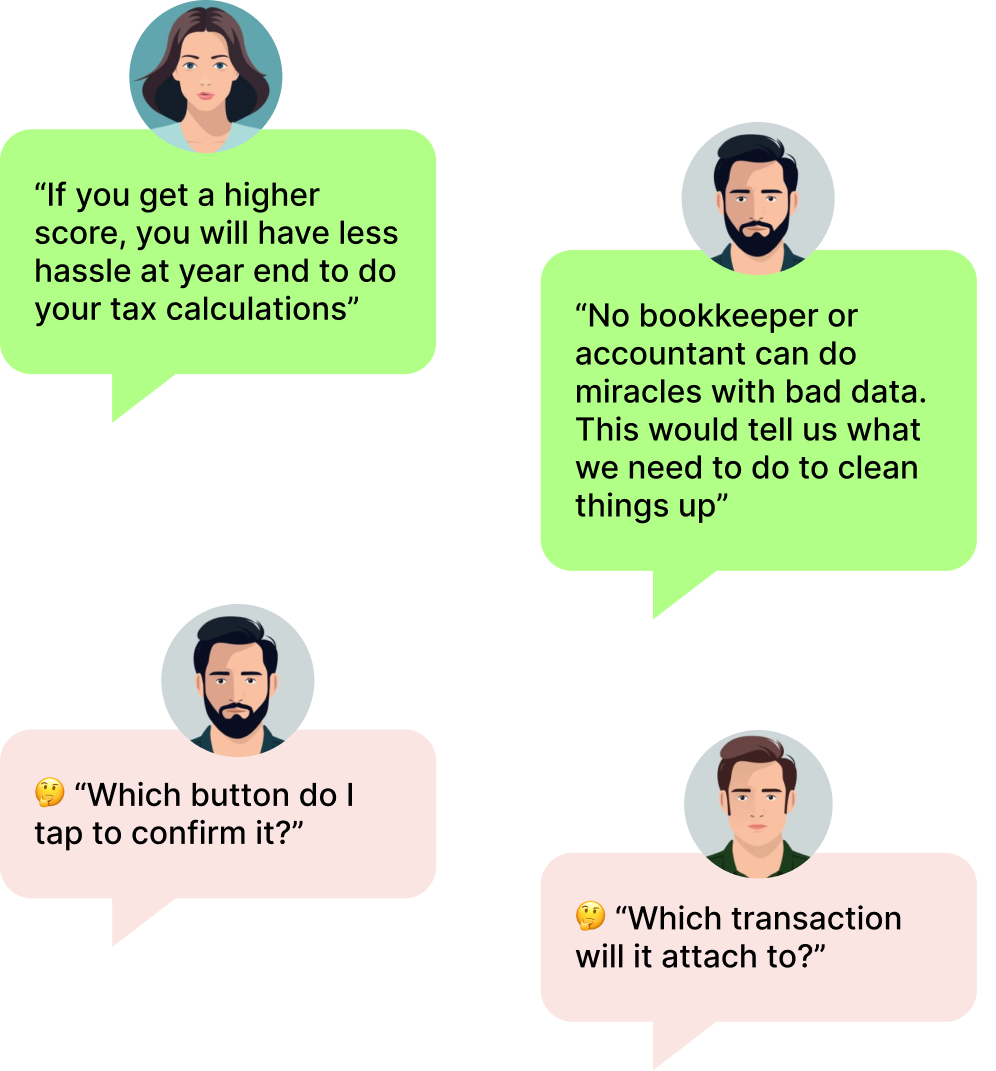
Testing backed the core idea. Customers said the score gave them clarity and a goal, and the tasks matched how they think about bookkeeping.

It also showed some usability gaps. In the list view, several buttons sat close together and made people hesitate. These issues would apply across the ANNA platform, so I shared them with the design team and updated the concepts.

Quotes from test participants beside a task card, with questions like ‘Which button do I tap to confirm it?’

Process Step 5

I defined experience principles

I defined experience principles and aligned Data Science and our internal accountant on them. The scoring engine was then built around customer needs, not just accounting rules. Here are 3 we discussed and worked from.

  1. 01

    Only send impactful tasks

    Only show tasks that make an impact on company taxes, otherwise they’re doing unnecessary work

  2. 02

    Only send tasks AI can’t do

    Only show tasks that ANNA’s AI cannot complete automatically for the user ahead of time

  3. 03

    Don’t overwhelm users

    Spread a large number of tasks across the year (throttle them if too many), so tasks never pile up

Process Step 6

I created content and flows

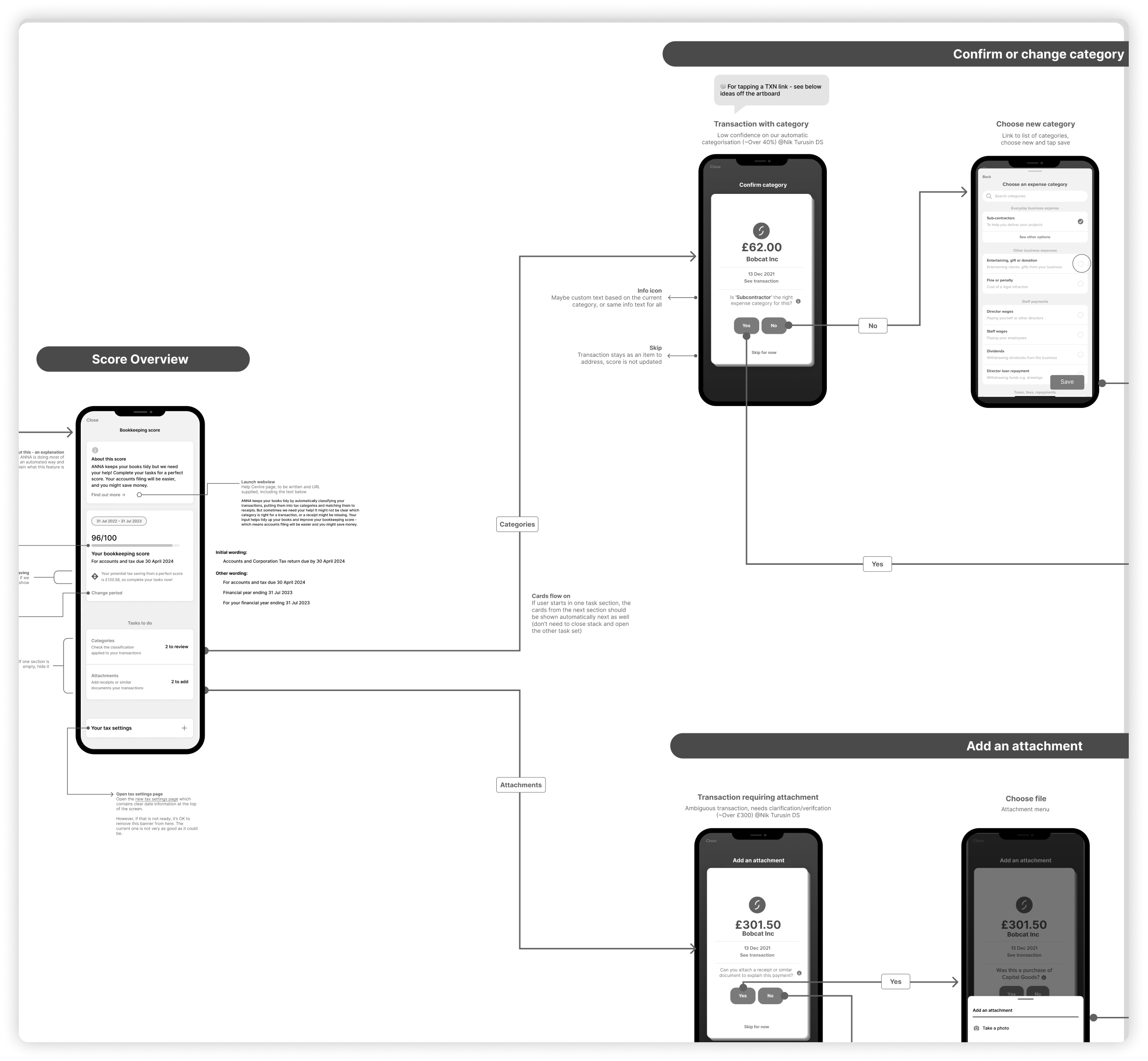
I mapped the full scope in flows and wireframes, exploring ways to approach the UI. This was in 2023, when wireframing was the status quo.

At this point, the project pivoted to mobile-first based on traffic. Here is where I began to bet on a Yes / No pattern, because a playful interaction would make a dreaded financial chore something customers came back to.

Mobile user flows and wireframes for the Bookkeeping Score tasks

Process Step 7

I collaborated with a Design Systems designer

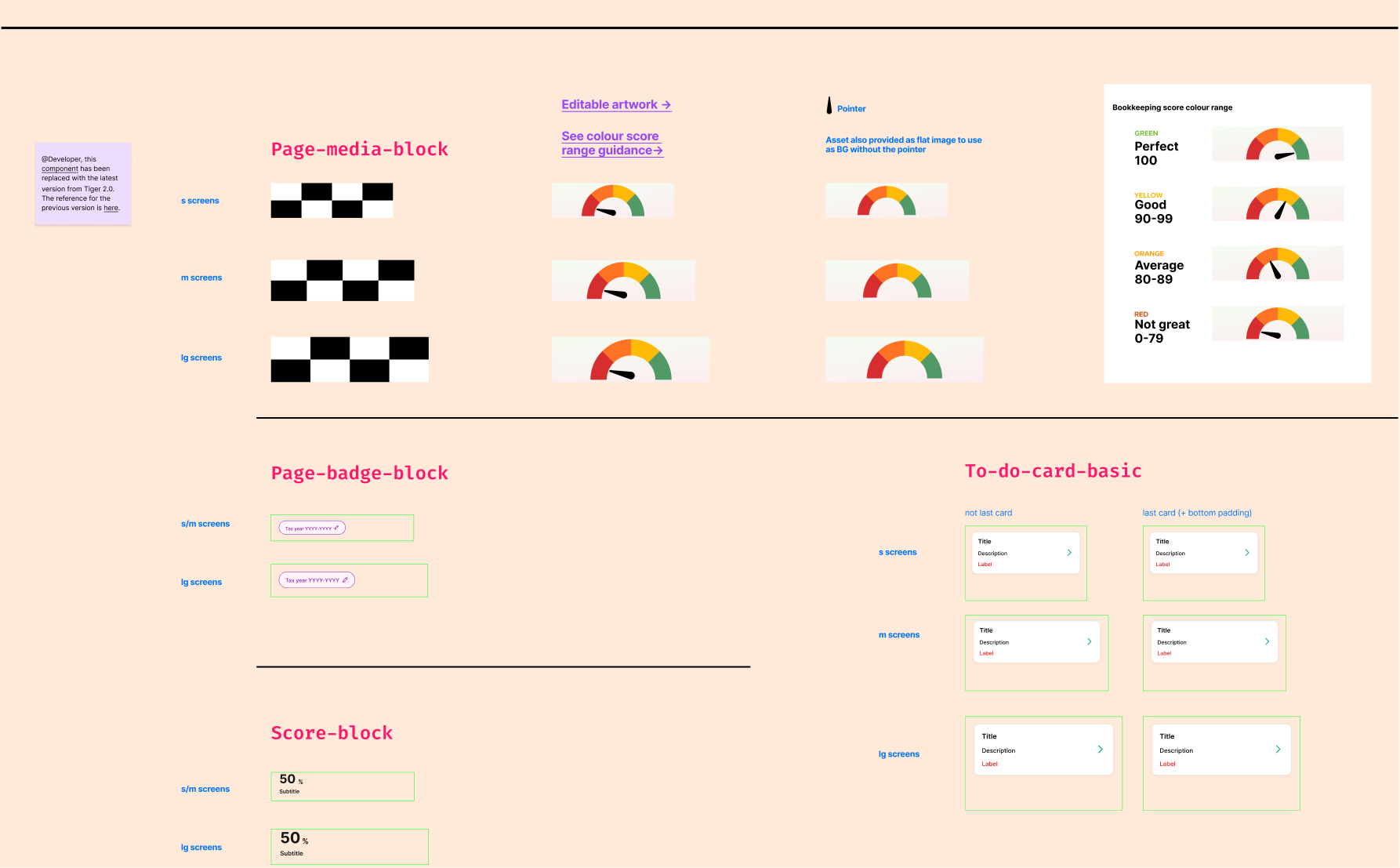
The design system wasn’t cohesive enough to build screens from. With the flows, wireframes and content in a good place, I partnered with our Design Systems designer, who helped create new components and take the screens to high fidelity.

Design system components for the score meter, with its colour range from red to green

Solutions

View some of the final designs that shipped for the Bookkeeping Score

Chat skills to reach customers

ANNA had used conversation design as a key interaction model since the company started.

I wrote chat flows to promote the tool, send weekly reminders, prompt subscriptions at the end of a trial, and respond to users who asked about their score in their own words.

Weekly reminders help people chip away at tasks in regular cycles before they pile up – something research had highlighted as an issue.
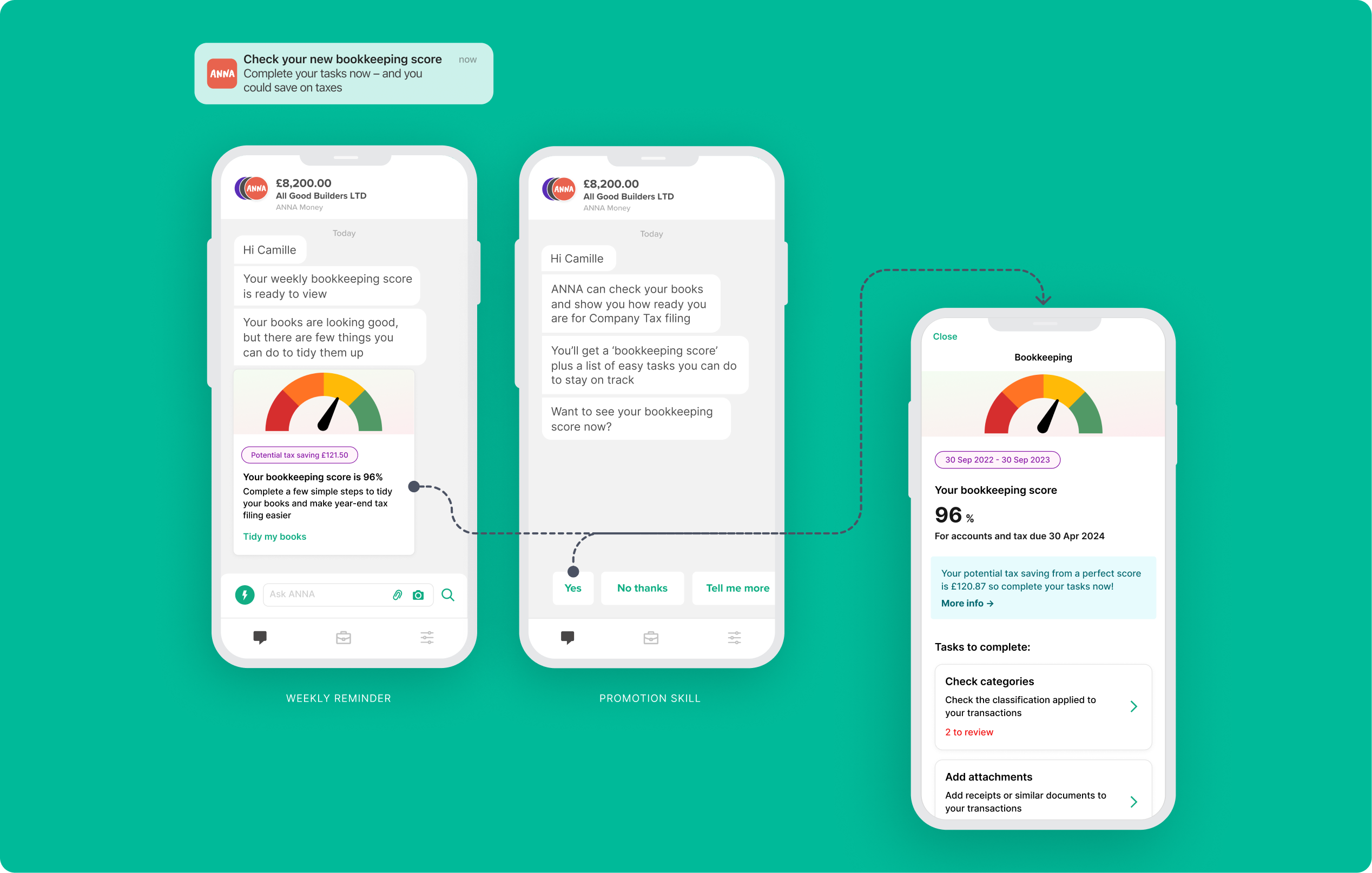
A weekly reminder and a promotion chat flow, both leading to the Bookkeeping Score screen

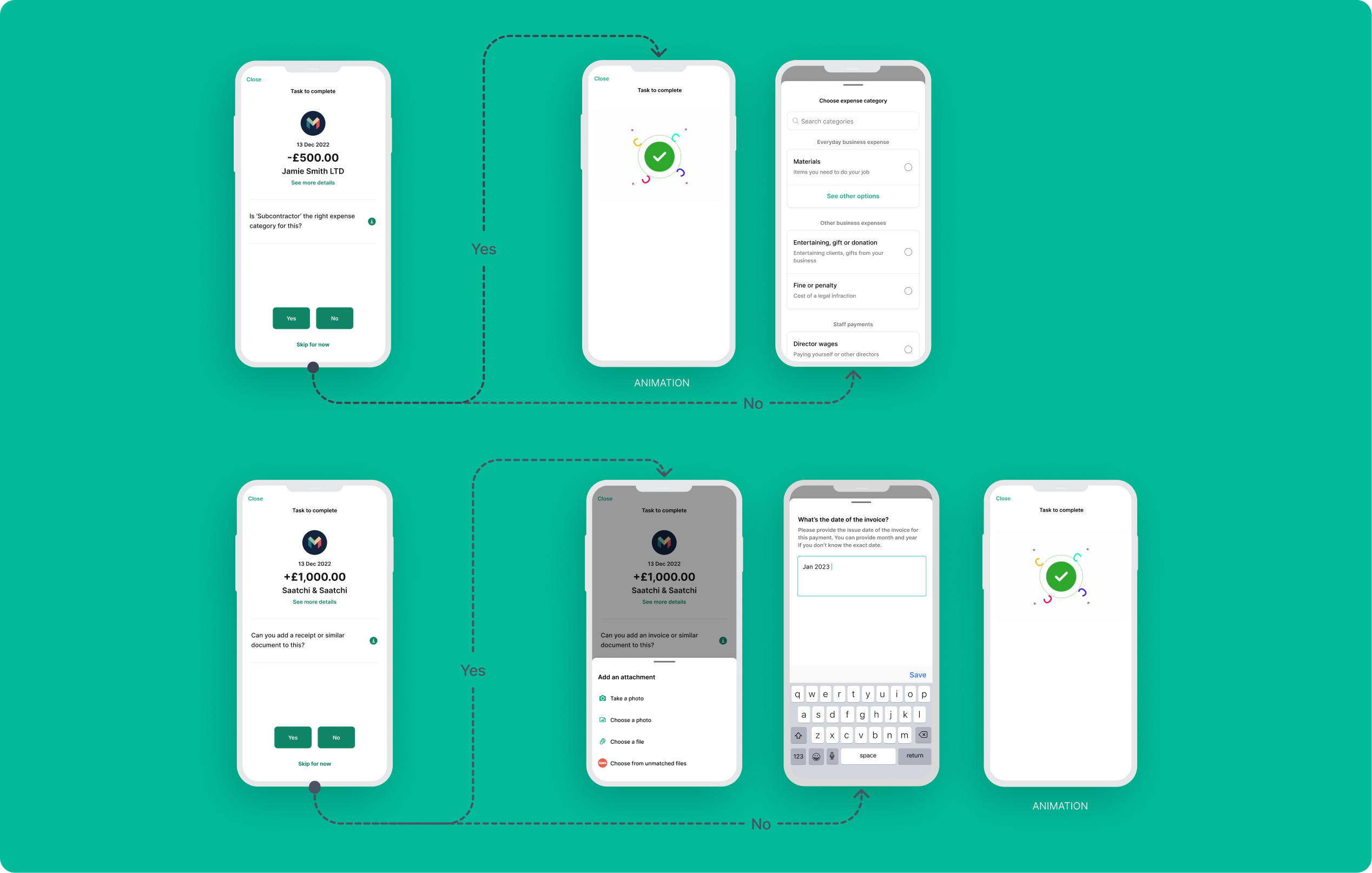
Tasks become one quick decision at a time

A simple Yes / No interaction turns complex bookkeeping tasks into one decision at a time, reducing cognitive load. Fitting a range of different tasks into one pattern took careful thought.

Research showed customers’ records were often a mess, so small, simple tasks cut through the confusion. Framing bookkeeping as clear actions meant less head-scratching over their own messy records. And it turned out to be fun to use!

Yes / No task cards asking the user to confirm an expense category, add a receipt and give an invoice date

A meter gives people something to aim for

Gamification research shows people are motivated by accomplishment, so I designed the experience to steer users towards a perfect score.

The meter gives users a visual sense of how healthy their bookkeeping is, and moves up as it improves.

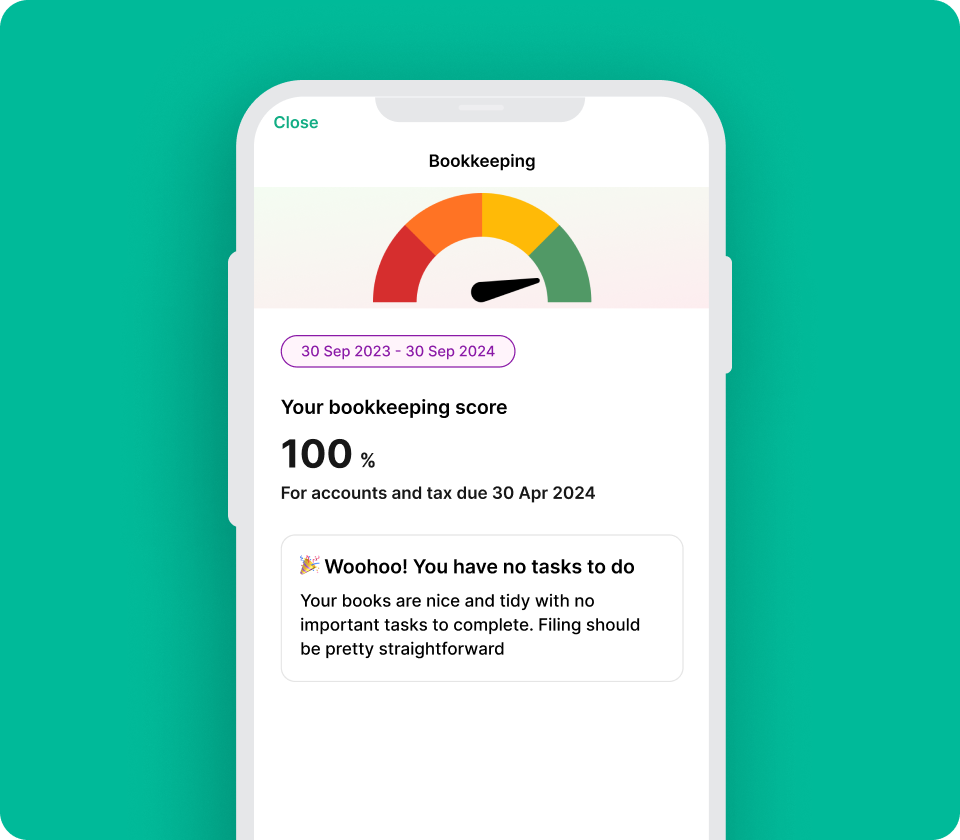
The Bookkeeping Score screen showing a full meter at 100% and no tasks left to do

Users are financially rewarded for doing their bookkeeping

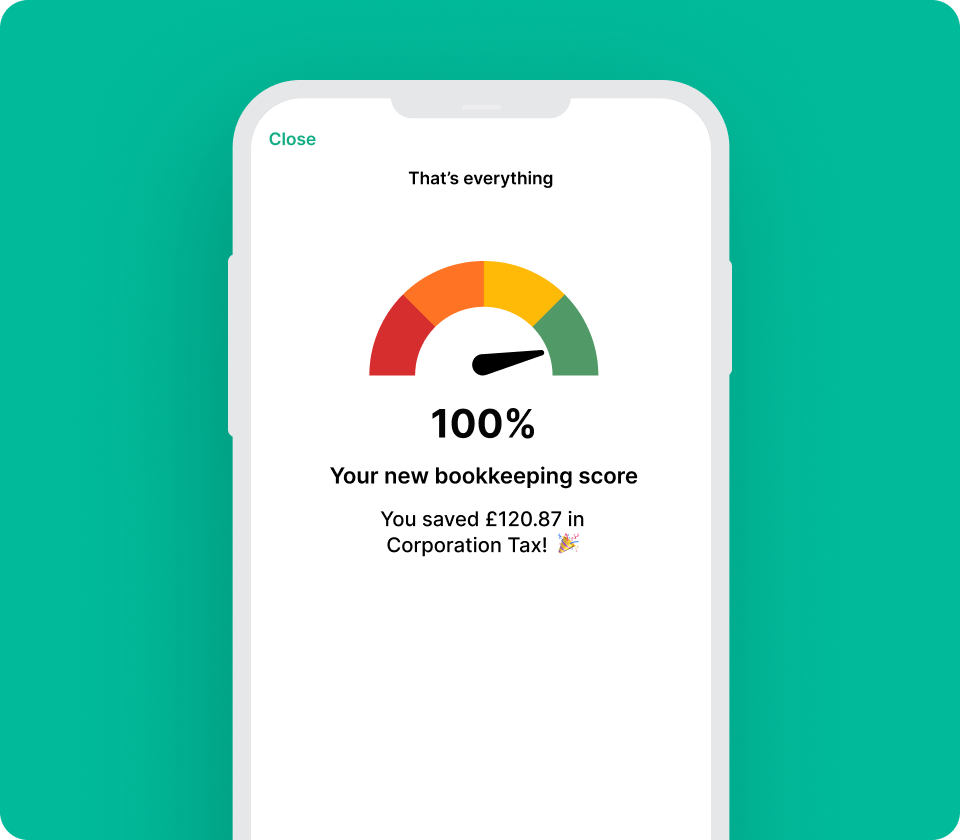
Users get a small dopamine reward for completing a task, a bigger one for reaching a perfect score, and a bigger financial reward when they save on Corporation Tax.

This tied back to the research, where business owners wanted to pay less tax.

Completion screen showing a new score of 100% and a £120.87 Corporation Tax saving

Protecting the experience as it grew

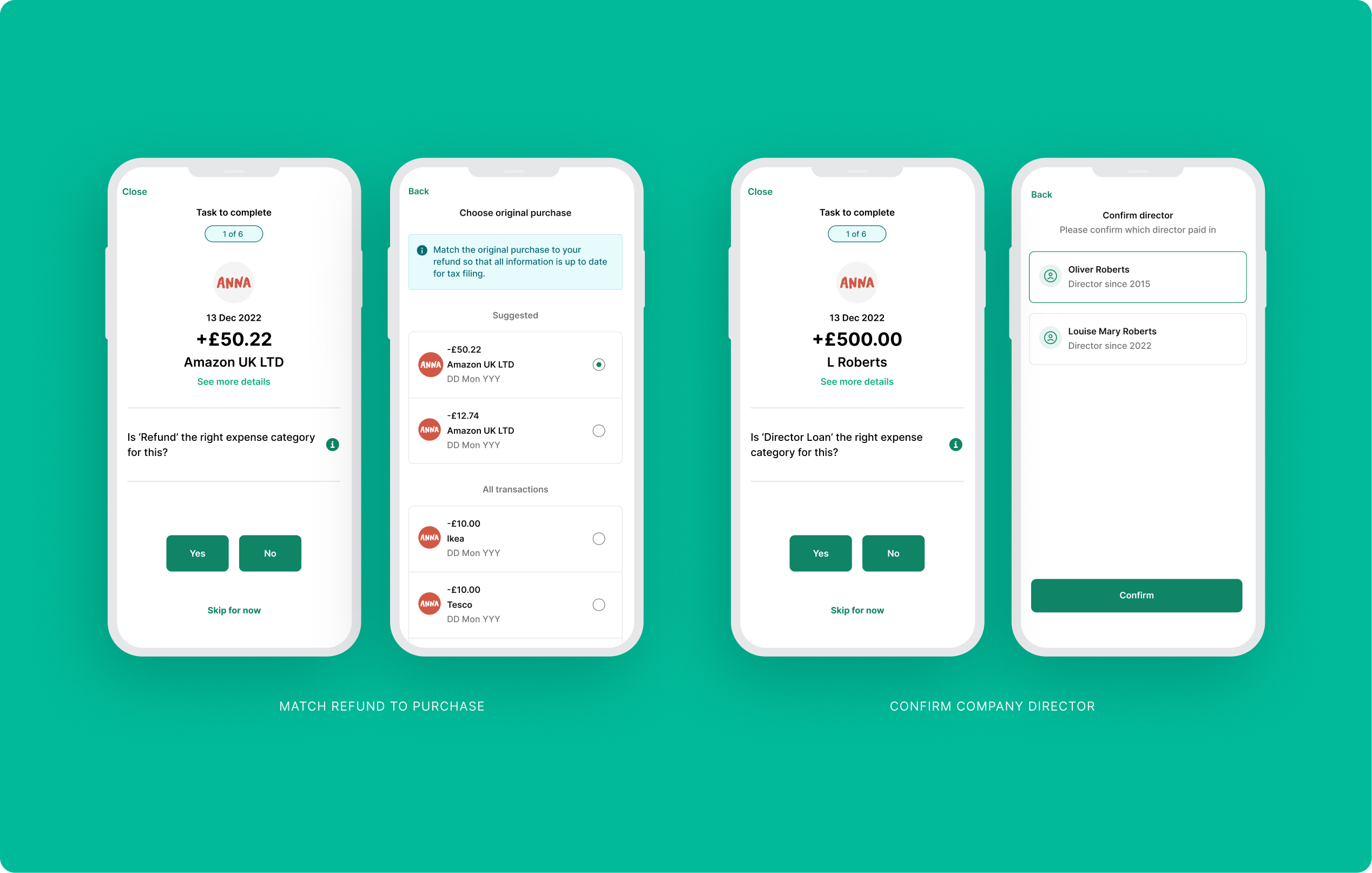
As new tasks came up, I designed them to fit the same simple Yes / No pattern. For example, users could match a refund to its original purchase, or confirm which director paid money into the business.

Protecting the experience was a challenge. The wider team often wanted to add all kinds of tasks to the Bookkeeping Score, and the core pattern was at risk of drifting into a mix of inconsistent interactions. For tasks that didn’t fit, I recommended other solutions to keep the Bookkeeping Score experience simple and consistent.

Task flows for matching a refund to the original purchase and confirming which director paid in

Outcomes

The impact

Users love the tool and are tidying their books

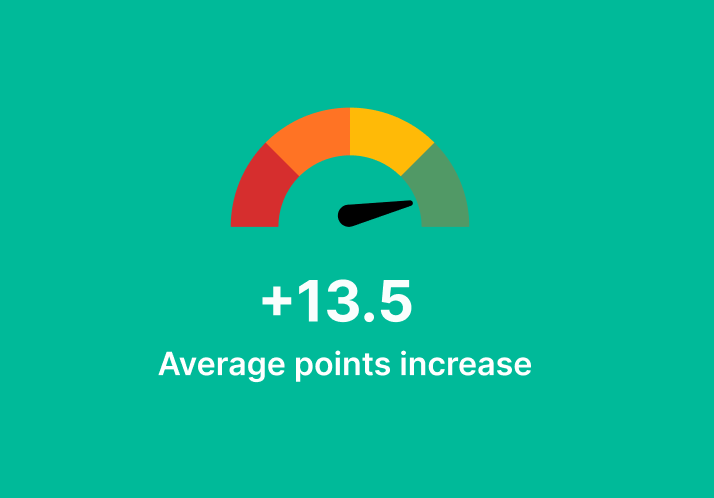
  • Score meter showing an average increase of 13.5 points

    +13.5 points increase

    In a completed session, the average user improves their Bookkeeping Score by 13.5 points, tidying their books along the way.

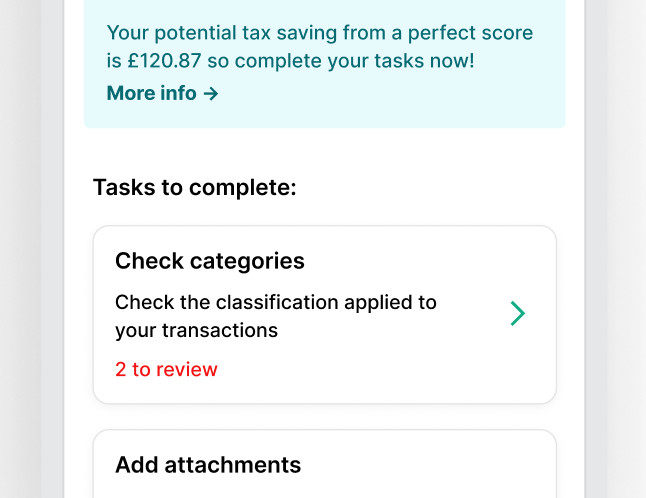
  • Task list showing categories to check and attachments to add

    79,024 tasks completed

    79,024 bookkeeping tasks were completed in 6 months, helping ANNA to file customers’ tax returns for them.

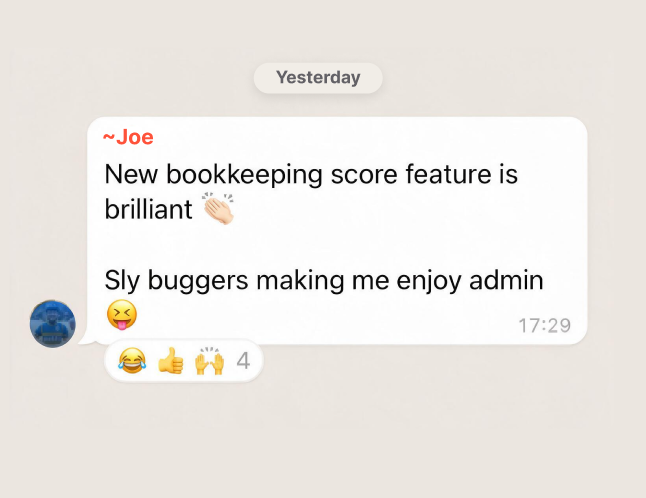
  • Chat message from a customer saying the new bookkeeping score feature is brilliant

    19% of subscriptions

    Bookkeeping Score drove 19% of paid subscriptions across ANNA’s features and filing tools. 73% of its trial users converted to paid, nearly twice the 38% average.

Post release

Two competitors built something similar

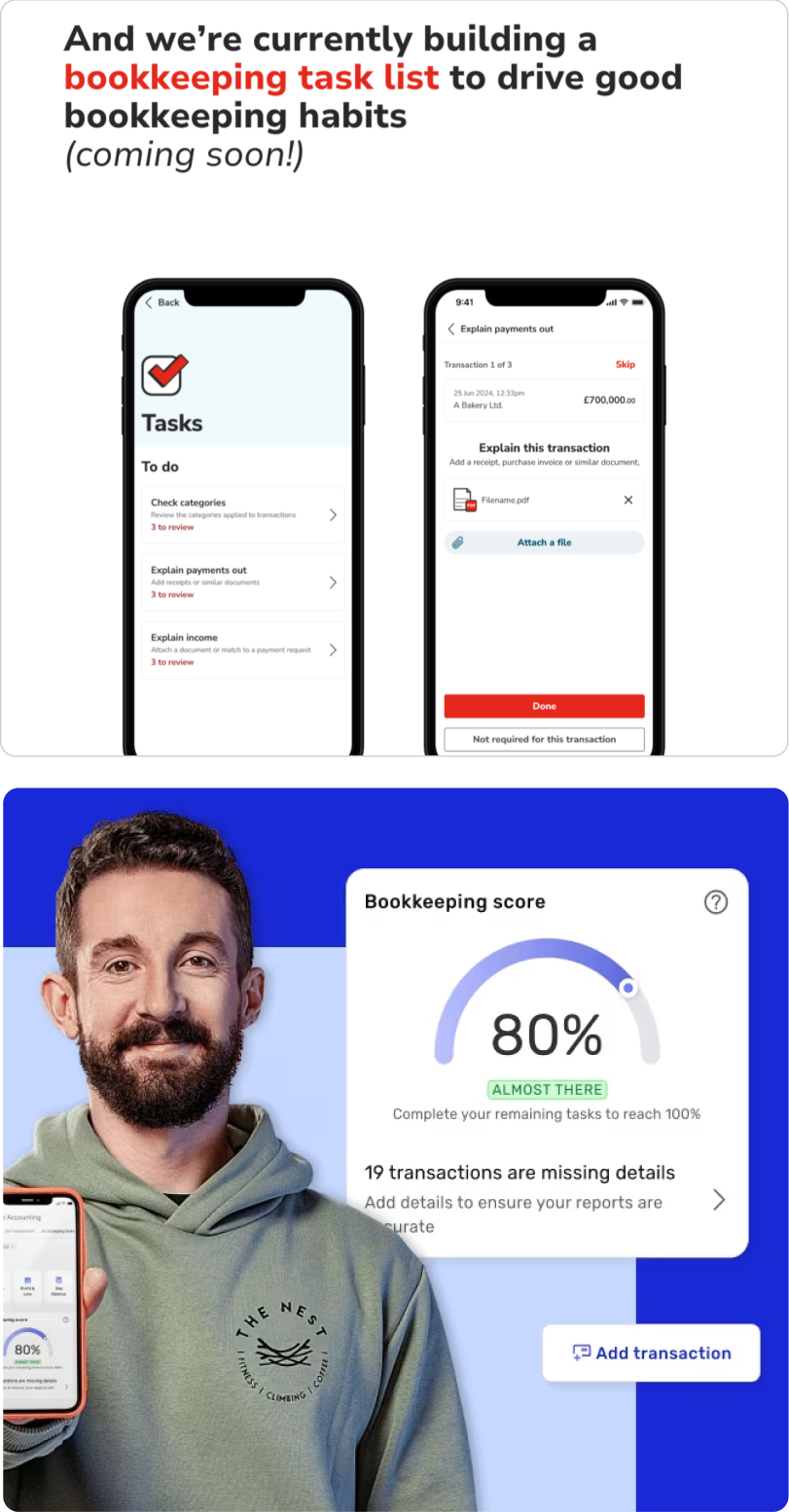
After we released the Bookkeeping Score mid 2023, both Tide and Counting Up released a similar experience. I don’t have the full picture on dates and details, but it’s lovely to see a great pattern for helping small business owners complete their bookkeeping be established across an industry.

Similar bookkeeping health features from Counting Up and Tide, released in July 2024

Ask questions and learn more

Book a call with me and I’ll walk you through the full story and answer any questions you have